PanelVerse
Original comics and manga
Browse illustrated fiction built for focused reading across phone, tablet, and desktop.
PanelVerse
Browse illustrated fiction built for focused reading across phone, tablet, and desktop.
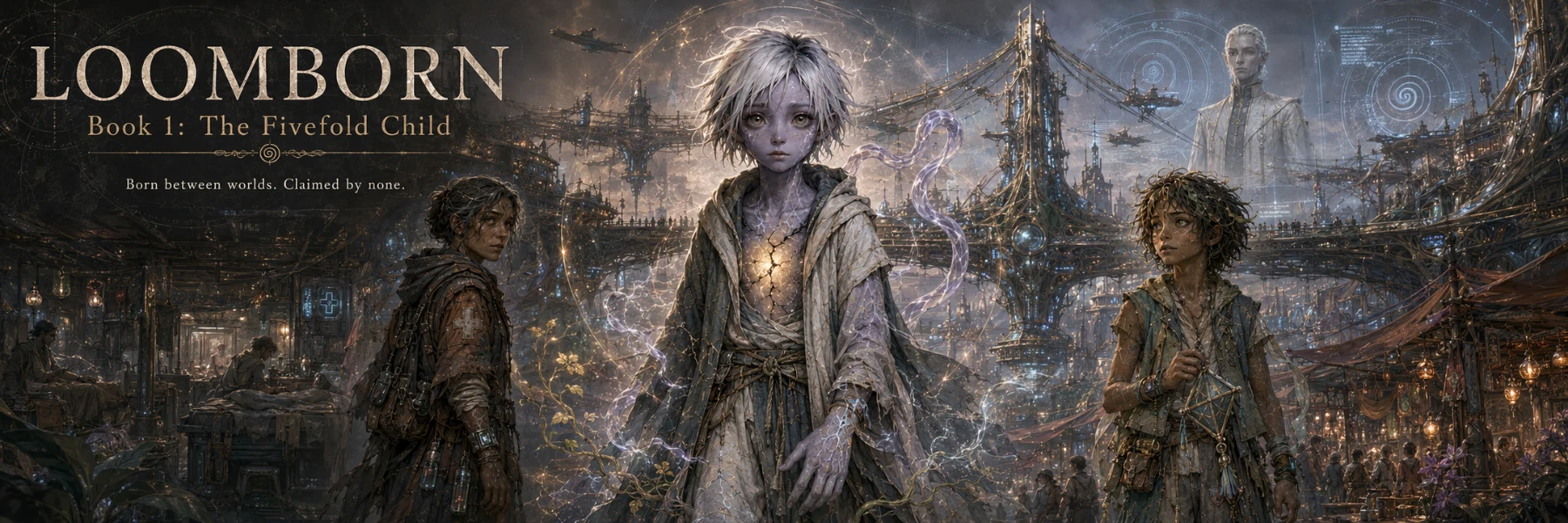
LOOMBORN: The Fivefold Child
A sci-fantasy graphic novel about an alien child born between five worlds, claimed by none.
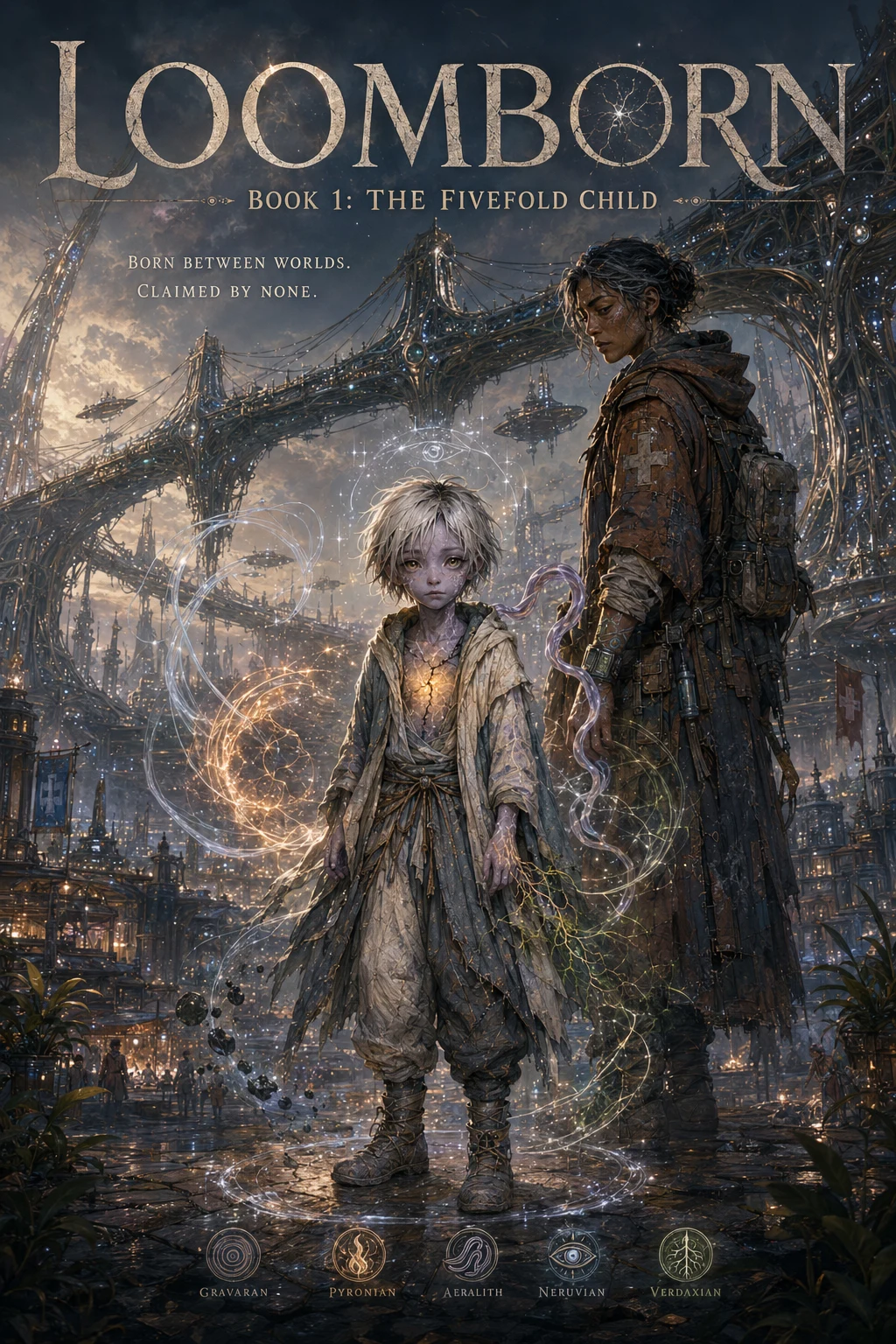
LOOMBORN: The Fivefold Child follows Auri Vey, a young non-human alien child living hidden in Veyr Crossing, a mixed settlement built around a dangerous gravity bridge. Raised by their guardian Seyra Vey, Auri has spent their life hiding strange symptoms under the name “bridge sickness.” But when the bridge begins to fail and Seyra is put in danger, Auri’s secret becomes impossible to hide. Auri carries five incompatible alien life-systems inside one unstable body. To some, they are a miracle. To others, a threat, a weapon, or something that must be controlled. But Auri only wants the right to choose what they are before the worlds decide for them.
Reading order
10 readable
Chapter 1
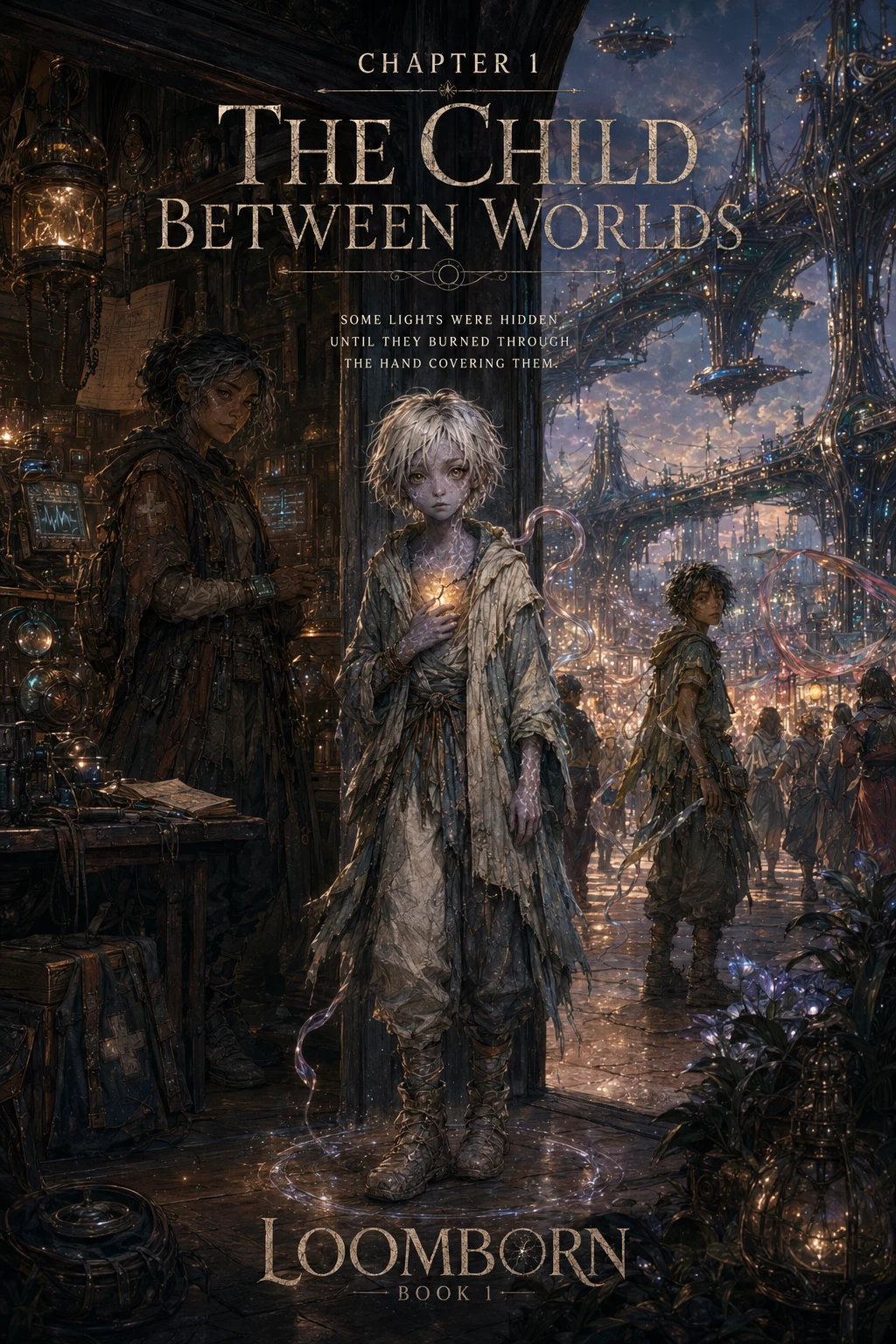
22 pagesAuri Vey works quietly beside Seyra in the bridge clinic of Veyr Crossing, helping treat strange cases of bridge sickness. But every emergency begins to echo one hidden part of Auri’s body: weight, heat, memory, motion, and something darker underneath. By the end of the day, the gravity bridge does not just fail — it answers Auri directly.
Chapter 2
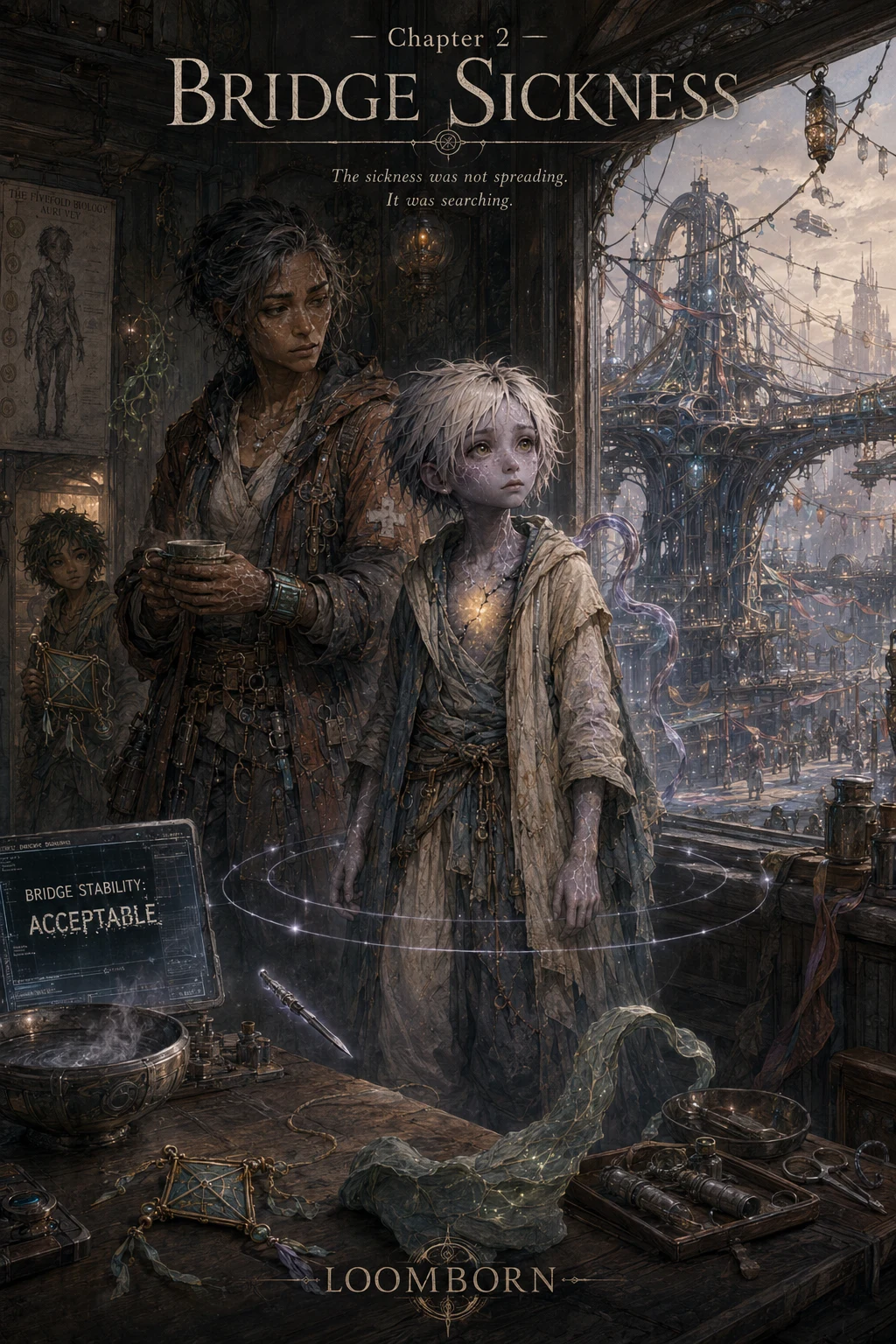
After the bridge-light festival, Auri wakes to a city pretending nothing happened. Seyra checks Auri carefully, searching for the strange black-silver crack from Chapter 1, but it has vanished. Auri notices that Seyra is hiding fear behind care, and their relationship begins to strain under all the secrets. At the clinic, patients arrive with impossible symptoms. A Gravaran child begins floating. A Pyronian vendor burns too hot from within. A Neruvian quiet chamber leaks private memories. A Verdaxian healing garden reaches toward Auri like it recognizes them. Each symptom reflects one part of Auri’s strange fivefold nature. Auri tries to help quietly, but their hidden abilities keep echoing the sickness around them. Kess sees enough to realize something is happening, but chooses not to force Auri to explain before they are ready. As the sickness spreads beyond the clinic, Veyr Crossing itself begins to fail. Transit towers drift off-pattern, roots grow toward the bridge, memory-light leaks through the city, and public systems finally detect a pattern. The Accord begins watching. Seyra prepares an emergency bag, revealing that she has been ready to run with Auri before. Auri discovers part of a hidden document saying they were found after forbidden transit and that their symptoms should be recorded as Bridge Sickness to avoid Accord examination. By the end of the chapter, Auri’s gravity ring divides into five directions, all pulled toward the bridge. Auri whispers in their sleep: “Please stop calling me.” Chapter 2 reveals that Bridge Sickness is not random illness. Something in the bridge is reaching for Auri — and the city may be reading them back.
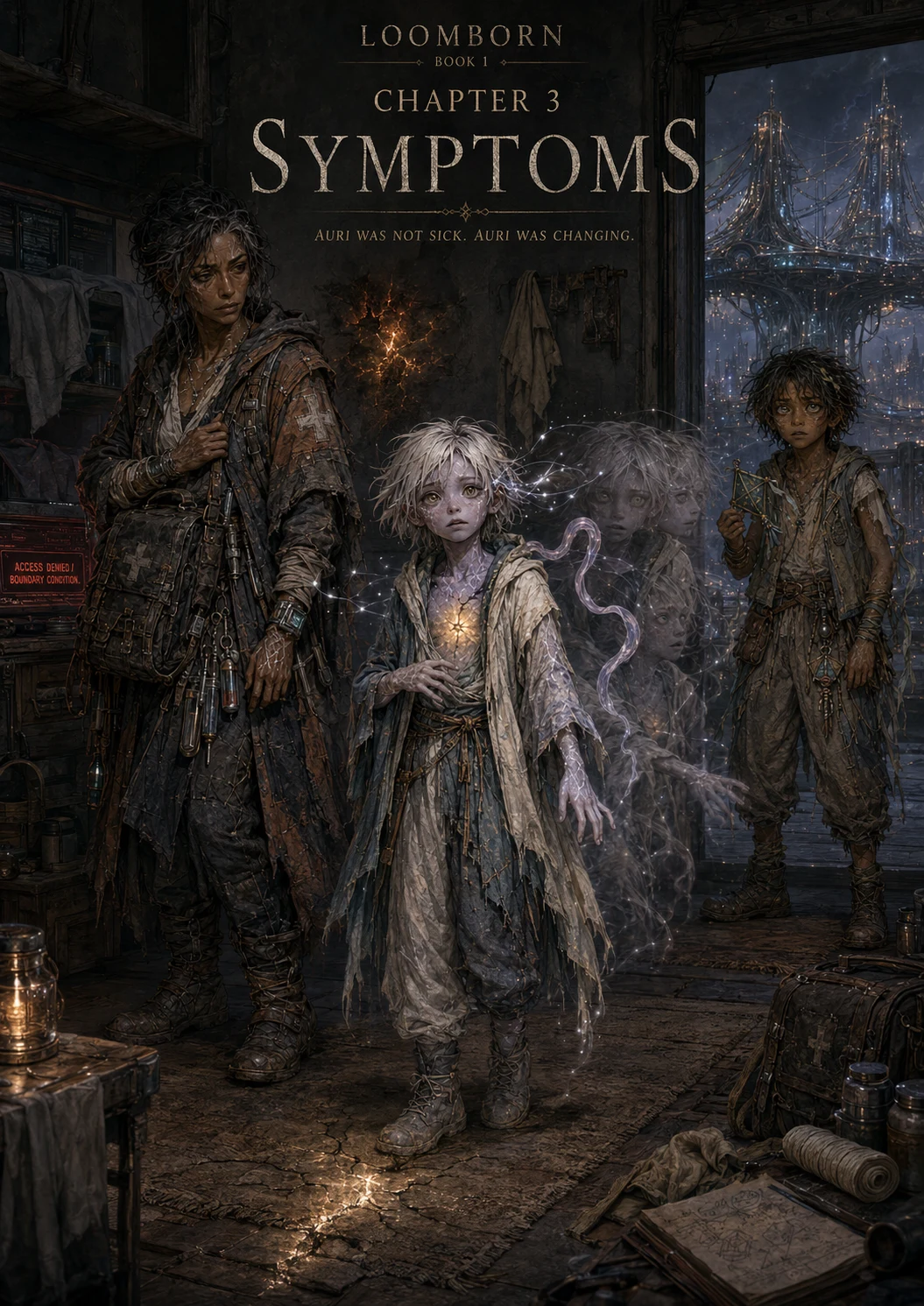
Chapter 3
22 pagesAfter the bridge calls to Auri in the night, Auri tries to force themself to become ordinary. At Seyra’s clinic, the symptoms from Bridge Sickness no longer feel random. Seyra begins writing a private list: weight, heat, motion, memory, growth, and the unknown black-silver pattern. But the list is incomplete, hidden, and frightening because each response seems connected to Auri. As the day continues, Auri’s body reacts to emotions before Auri can control it. Fear makes the floor crack. Anger leaves a scorch mark. Panic splits direction. Pain triggers growth. Curiosity opens memory-signals that reveal things Auri did not mean to see. Kess stays close, but the friendship becomes fragile as Auri’s abilities begin touching private feelings and memories. Seyra tries to protect Auri, but protection keeps looking like concealment. Auri starts pushing back, asking whether they are being cared for or studied. By the end of the chapter, Auri and Seyra finally name the truth: Auri is not sick. Auri is changing. Then the city shifts from quiet fear into disaster. The gravity bridge pulses above Veyr Crossing, echoing all five symptoms across the city at once: weight, heat, motion, memory, and growth. The public screens flash: BRIDGE COLLAPSE WARNING THIS IS NOT A DRILL Chapter 3 ends with the hiding over. The bridge is no longer just calling Auri. It is answering them.
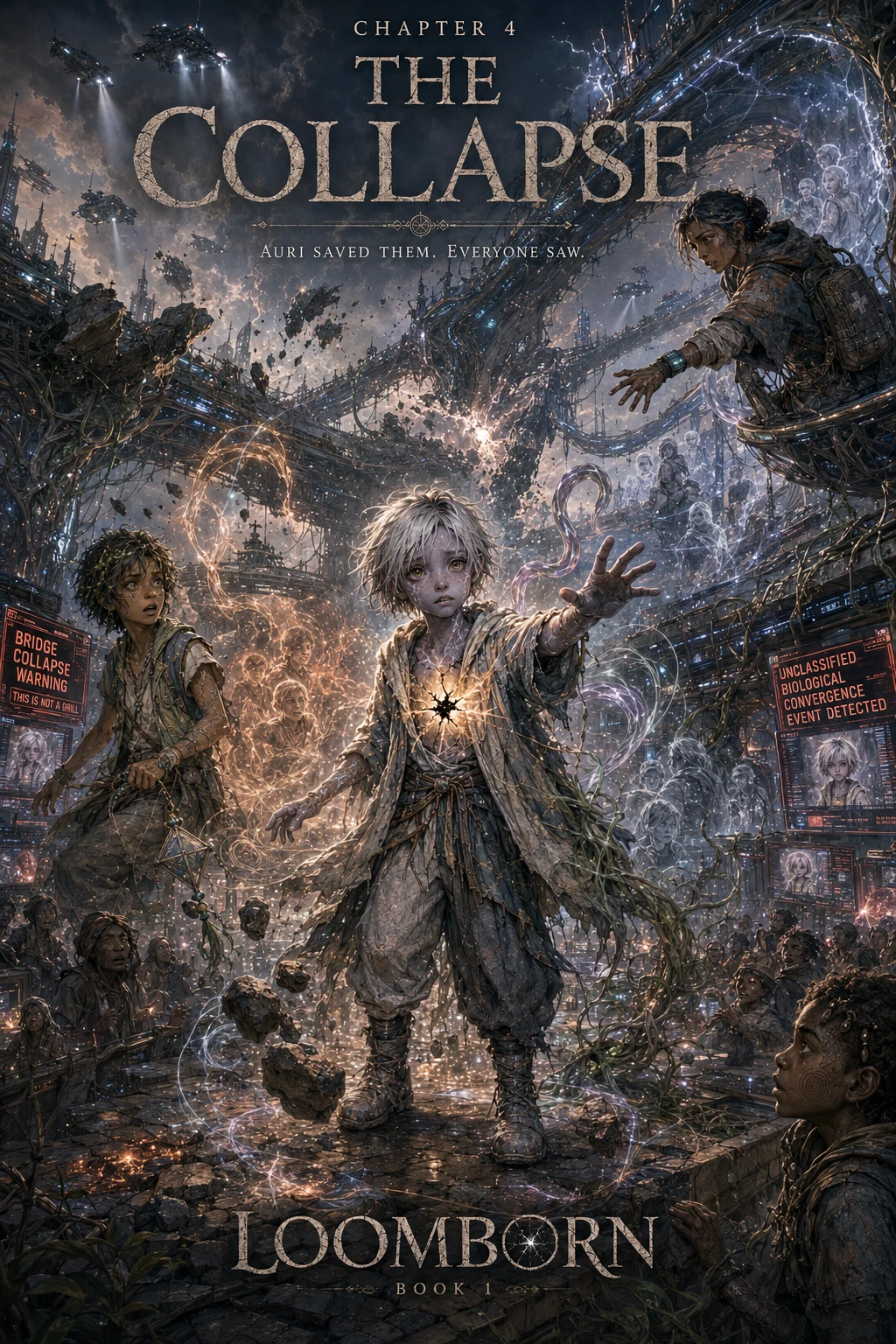
Chapter 4
22 pagesChapter 4 is the point of no return for LOOMBORN. The gravity bridge above Veyr Crossing begins to collapse in impossible ways. It does not simply break — it folds, bends, and twists like space itself is being pressed out of shape. Public screens flash emergency warnings, and Seyra immediately runs toward the bridge as a medic. Auri is told to stay hidden. Seyra knows that if anyone sees what Auri can do, the danger will no longer be only the bridge. It will become the Accord, the public, and the fear of being classified. But when Seyra becomes trapped inside the broken bridge, Auri chooses her over secrecy. As Auri enters the collapse, each part of their strange fivefold nature responds under pressure. Gravity delays falling structures. Heat opens a painful path through the mist. Motion splits possible directions. Memory reveals trapped civilians. Growth loosens dangerous vines. None of it feels like mastery. Every save costs Auri something visible. Then the sixth response appears: a black-silver silence where reality itself pauses. Sirens hang unfinished. Falling stones wait. Heat, memory, motion, and growth freeze for one impossible moment. Auri is not controlling it — they are the place where reality stops. Auri reaches Seyra and saves civilians, but the rescue exposes them completely. Accord ships descend with cold scanning lights, public screens lock onto Auri’s body, and the official system names them an unclassified biological convergence event. By the end of the chapter, thousands of people have seen Auri. They saved lives. But they lost hiding. Chapter 4 changes the story forever: before this, Auri was a secret. After this, Auri becomes evidence.
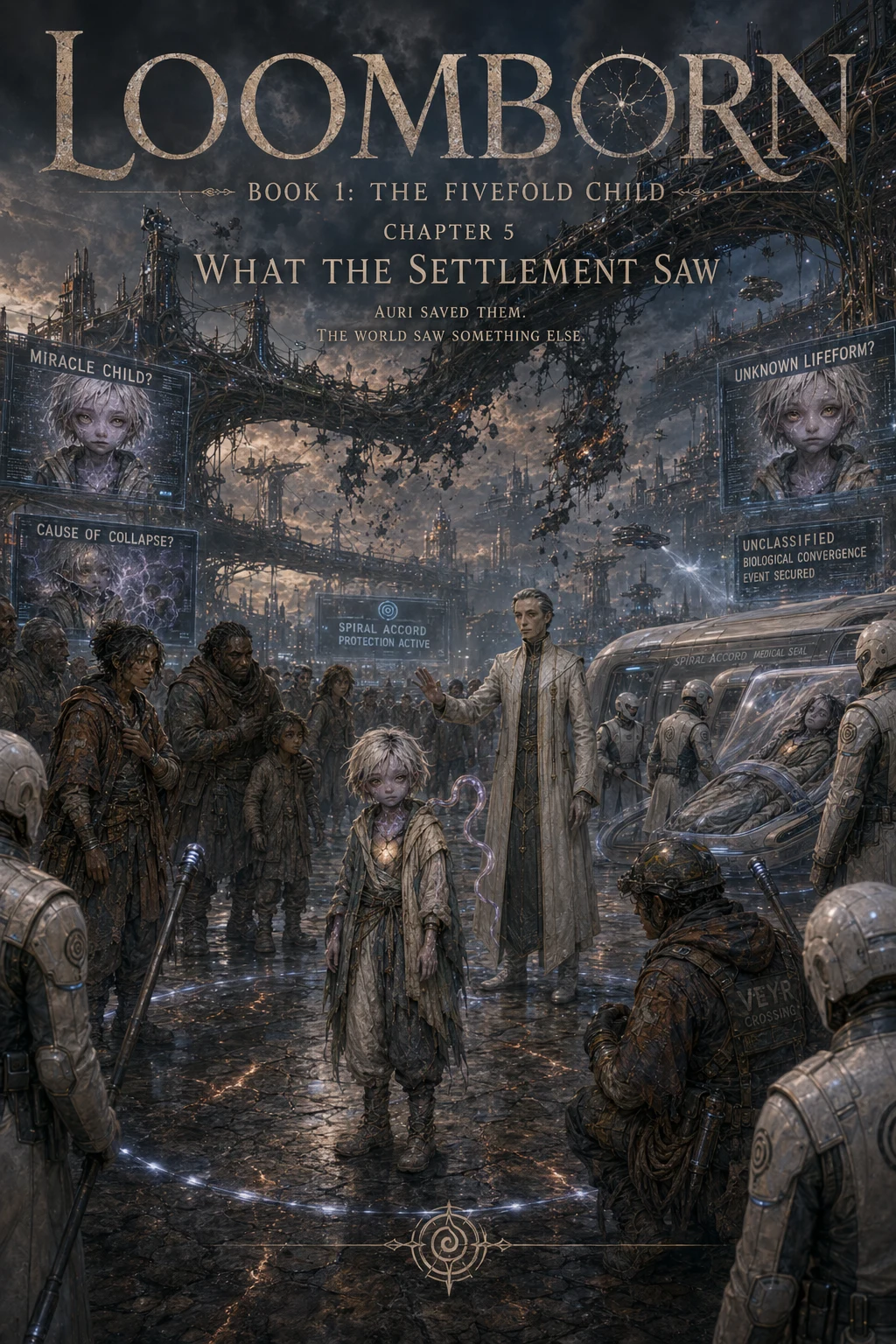
Chapter 5
22 pagesAfter the gravity bridge collapse, Auri stands exposed in front of Veyr Crossing. They saved civilians and reached Seyra, but no one knows how to understand what they witnessed. The first reaction is not celebration. It is recording, staring, and fear. At first, some people see Auri as a miracle. Others see them as something connected to the bridge. The same image spreads across public screens with different meanings: miracle, monster, cause. Auri has not explained anything, but the settlement is already creating stories about them. The chapter’s emotional wounds come from separation. Kess is scared and takes one small step back. Seyra tries to defend Auri, but her voice is cut off by the public system. When Seyra is placed in medical isolation, Auri cannot even find the right legal word for what Seyra is to them. Guardian, parent, protector, the person who lied, the person who stayed — none of the words are enough. Then the Spiral Accord arrives. Magistrate Oryn Vhal speaks gently, but every sentence turns Auri into a record, a category, or an object of procedure. Auri says, “My name is Auri.” Oryn answers, “For now, yes.” By the end, the Accord calls it protection, but it looks and feels like custody. Auri stands inside an official circle while Seyra is taken to a separate transport and Kess remains outside. Chapter 5 is about the moment rescue becomes evidence. Auri saved people. But the settlement saw a threat. And the Accord saw something claimable.
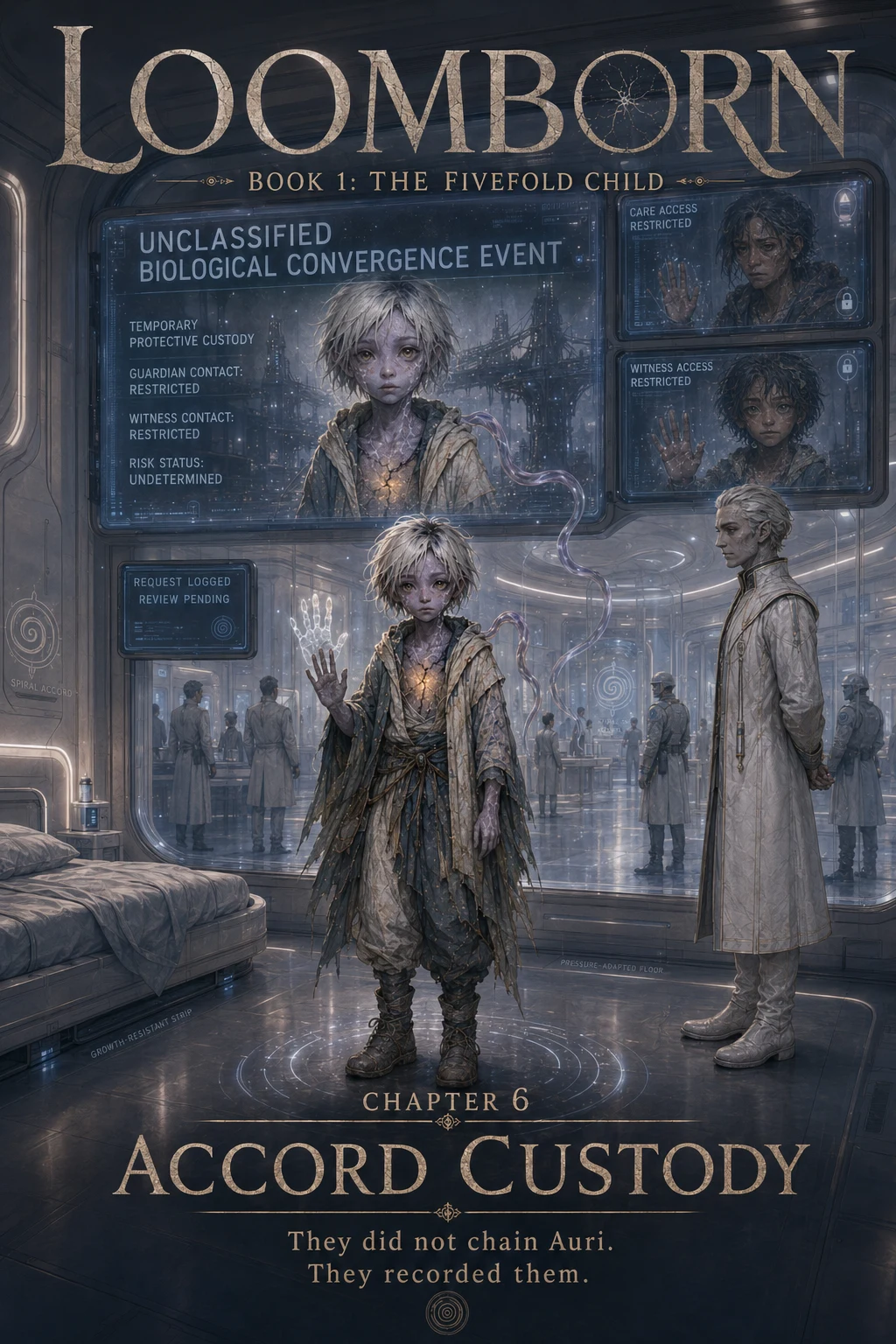
Chapter 6
22 pagesChapter 6 is not about violence. It is about being handled. After the collapse, the Spiral Accord moves Auri away from the broken bridge in a calm, precise circle. No one touches them. No one raises a weapon. But every step makes it clear that Auri is no longer free to choose where they go. Seyra’s medical transport is sent one way, while Auri is taken somewhere else. Auri believes “protection” should mean being helped back to Seyra. Instead, protection becomes separation. Kess is renamed as a witness. Seyra becomes a scheduled contact request. Auri becomes a subject of scans, interviews, and intake records. Their name is acknowledged, but the Accord keeps reducing them into categories. Inside the Accord facility, everything looks clean, gentle, and safe. That is what makes it frightening. The observation room has a bed, water, soft lighting, and transparent walls, but it also reacts to Auri’s body before Auri understands it. The room thickens, cools, dims, records, and learns how to contain them. The deepest wound comes from language. Auri tells the interviewer they entered the collapse because Seyra was trapped and people were falling. The system turns that story into a colder record: subject entered active collapse zone, motivation unverified, guardian connection high dependency. Auri’s feelings are not denied. They are translated into evidence. By the end of the chapter, Auri sees the official label: UNCLASSIFIED BIOLOGICAL CONVERGENCE EVENT TEMPORARY PROTECTIVE CUSTODY GUARDIAN ACCESS: RESTRICTED WITNESS ACCESS: RESTRICTED Auri understands that the Accord is not asking who they are. It is deciding what they are. So Auri creates a small act of resistance. They reject the old phrase, “Small body. Small breath. Small light,” because the room has learned to reward it as compliance. Instead, Auri whispers: “My body. My breath. My light.” The chapter ends with Auri alone beneath the official label, saying the truth the screen refuses to accept: “My name is Auri.” Chapter 6 is about custody disguised as care, and the first quiet moment where Auri begins to define themself back.
Chapter 7
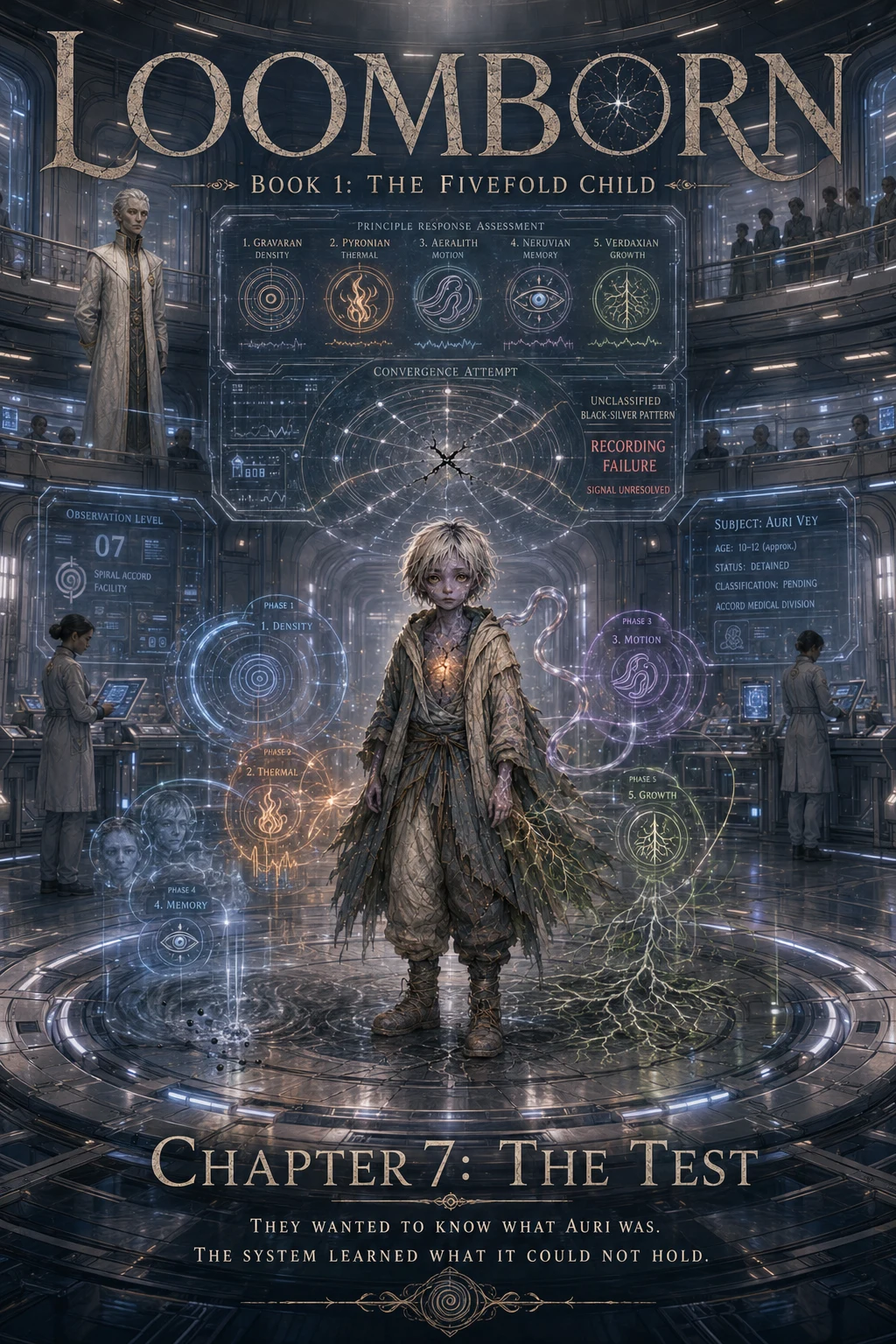
22 pagesChapter 7 turns Auri from a case file into a test subject. Auri wakes in the Accord observation room to a false morning. There is no window, no real sunrise, no city sounds, and no Seyra. Their first question is whether Seyra woke up, but the room only answers with another logged request. Before Oryn even enters, the room is already measuring Auri. Scanners track their density, thermal response, signal noise, and emotional state. When the Accord presents an evaluation consent slate, Auri asks what happens if they do not agree. The system records the refusal, then continues under emergency authority anyway. Consent has become decoration. The testing chamber is built around five recognized principles: Gravara, Pyronis, Aeralith, Neruvia, and Verdaxis. But Auri notices the missing truth immediately. There is no sixth door. No blank space. No place for the black-silver pattern. The room itself cannot imagine Auri’s full shape. One by one, the Accord tests Auri’s responses. Weight becomes burden. Heat becomes extraction. Motion becomes panic. Memory becomes pressure against a boundary. Growth becomes invasive care. Every test finds data, but each one also hurts Auri in a different way. The Accord keeps confirming pieces, while Auri keeps disappearing beneath the labels. The emotional center of the chapter comes when Auri says: “You found pieces. Where am I?” No screen answers. Then the Accord crosses the line. A scientist orders convergence pressure, forcing all five systems to activate at once. The specialists hesitate, but the chamber proceeds. Weight, heat, motion, memory, and growth collide inside Auri. The test stops being clinical and becomes a violation. That is when the missing sixth pattern appears. The black-silver crack opens like a refusal. Weight forgets to press. Heat forgets to burn. Motion forgets direction. Memory forgets images. Growth forgets reaching. For one moment, the chamber obeys Auri’s quiet “No.” The Accord cannot classify what happened. Its labels fail until only one phrase remains: UNNAMED PATTERN DETECTED Auri realizes the Accord does not know what they are. Oryn says, “Not yet,” and it sounds less like comfort than ownership of a new question. The chapter ends with Auri returned to the observation room, too exhausted to stand. The wall screen says the evaluation is incomplete, the unnamed pattern has been detected, and guardian contact is denied pending review. Auri looks only at the last line: Seyra. Alone in the room, Auri says: “My name is Auri.” The screen does not change. But the black-silver crack pulses once, like something inside Auri heard.
Chapter 8
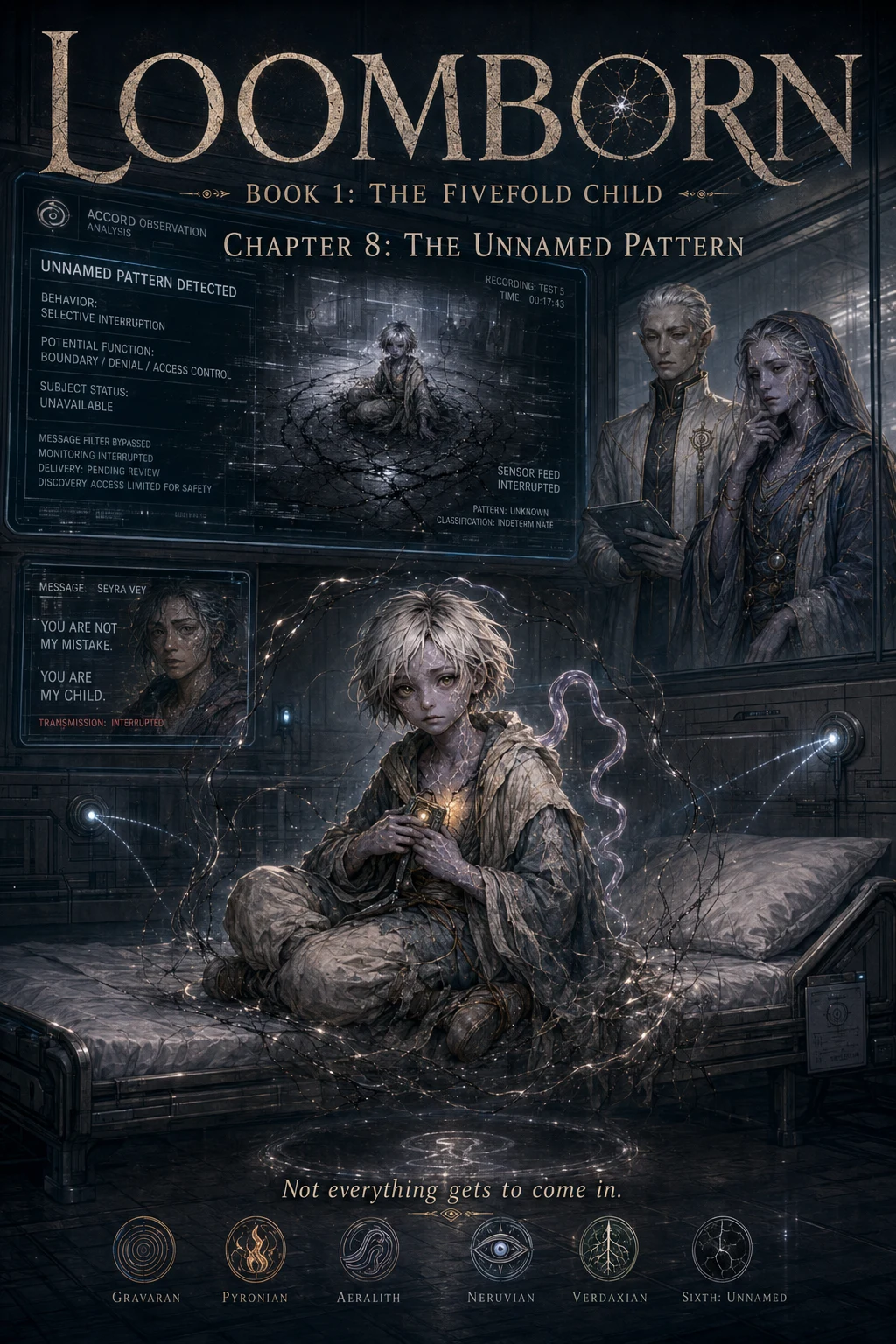
23 pagesChapter 8 begins after the failed Accord test. Auri is back in the observation room, but they are not truly recovering. Their body is still replaying the test: weight, heat, motion, memory, growth, and the black-silver pulse that the Accord cannot name. Above them, the screen still says UNNAMED PATTERN DETECTED and GUARDIAN CONTACT: DENIED PENDING REVIEW. In the Accord analysis room, Oryn and the specialists review the impossible recording from the test. The sixth shape should not exist, but one frame remains: a black-silver absence beneath Auri, shaped less like a symbol and more like refusal. The scientists argue over whether it is signal failure, geometry, absence, or something worse. The Neruvian specialist understands one terrifying thing: the pattern refused capture. Meanwhile, Auri begins to hear fragments through the facility. They hear the Accord discussing sealed copies, absence, and the question no one wants to say out loud: if absence is not a principle, why did every principle obey it? Auri realizes the Accord is scared. Seyra wakes in a medical room and immediately asks for Auri. The Accord frames her relationship as incomplete legal status, but Seyra refuses that language. She says Auri is her child, not a file under review. Kess also gives a statement, trying to protect Auri’s story, but the system twists even careful testimony into evidence. The middle of the chapter reveals what the unnamed pattern really begins to feel like for Auri. When too many voices press into them, Auri tries the word “No.” At first nothing happens. Then the black-silver crack pulses, and the voices stop. For the first time, Auri experiences a silence that is not emptiness or fear. It is a boundary. The Accord notices immediately. Their monitors lose access to Auri’s internal emotional state. Auri stops being readable, and Oryn realizes the pattern appears around intrusion, separation, names being taken, and unwanted entry. But Oryn only understands the danger strategically, not emotionally. The emotional climax comes when Seyra records a message for Auri. She tells Auri: “You are not what they call you.” “You are not what I hid either.” “You are not my mistake. You are my child.” The Accord holds the message for review, but Auri refuses the denial. For the first time, they use the unnamed pattern intentionally. Not to attack. Not to escape. To make one feeling untouchable. The system cannot enter that moment. By the end, the Accord records the unnamed pattern as selective interruption with a possible function of boundary / denial / access control. But Auri does not know those words yet. They only know the truth of the feeling: “Not everything gets to come in.” Chapter 8 reveals that Auri’s sixth pattern may not be a power in the usual sense. It is the beginning of consent, refusal, and selfhood.
Chapter 9
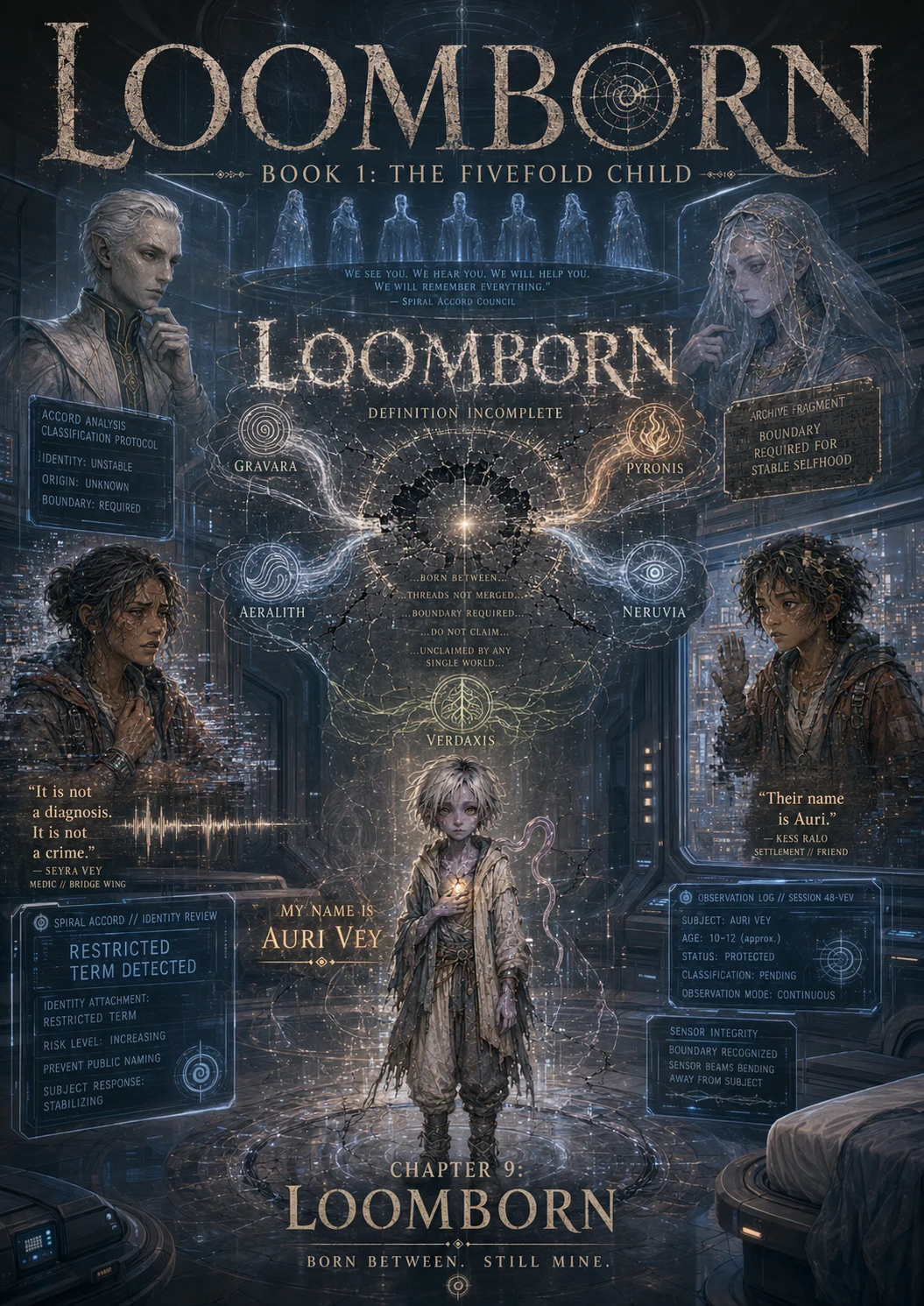
22 pagesChapter 9 reveals the forbidden word the Accord has been avoiding. After Auri’s unnamed pattern interrupts the test, Oryn and the Accord specialists open a restricted archive. The archive is old, unstable, and full of erased records. It does not give a clean explanation. Instead, it shows fragments: five principles crossing, a blank center, a required boundary, and warnings not to claim the child. Then the word appears: LOOMBORN The Accord treats the word like dangerous history. To them, it is not just a name. It is political, legal, and mythic evidence that predates their categories. They try to contain the record before it can become truth. But Auri feels the word from inside the observation room. It does not feel like the Accord’s labels. It does not feel like event, subject, or risk. It feels unsettling, but not like a cage. Seyra knows the word too. When she hears the restricted alert, she recognizes it immediately. To Seyra, “Loomborn” is a word people use when they want to make a child belong to history instead of themself. Still, she fights to reach Auri before the Accord defines the word first. Kess also hears the term through rumor and refuses to let it replace Auri’s name. They choose the words they know are true: Auri. Friend. The emotional turning point comes when Seyra breaks protocol and speaks to Auri through an audio line. She tells Auri that Loomborn is not a diagnosis and not a crime. It means Auri was: born where worlds were not supposed to touch. For the first time, the five parts of Auri do not feel only like symptoms. They feel like witnesses. The truth does not destabilize Auri. It steadies them. That becomes Oryn’s mistake: the Accord assumed knowledge would make Auri harder to contain, but the right truth makes Auri more whole. The archive eventually reveals one dangerous fragment: A life born between principles. Stabilized by boundary. Unclaimed by any single world. By the end, Auri begins to claim themself out loud: My name is Auri Vey. Seyra is my family. Kess is my friend. Loomborn. Born between. Still mine. Chapter 9 does not solve what Auri is. It gives Auri the first word that might belong to all of them.
Chapter 10
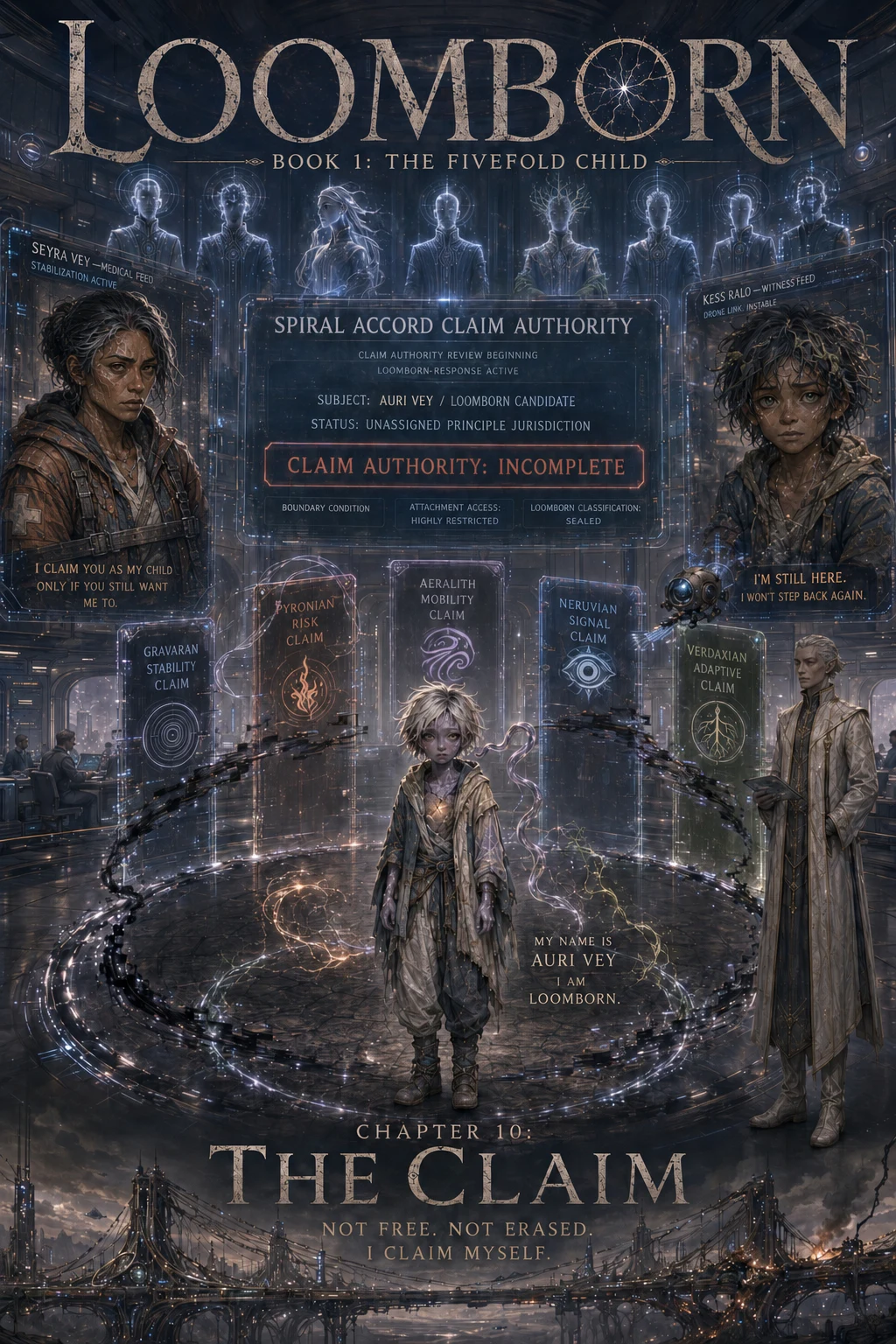
22 pagesChapter 10 is the finale of LOOMBORN Book 1: The Fivefold Child. After Chapter 9 gives Auri the word Loomborn, the Accord tries to decide what that word means before Auri can. The council issues a formal claim authority, treating Auri as an unassigned subject whose five principles can be divided into different jurisdictions. To the Accord, this is legal protection. To Auri, it is possession. The claim document breaks Auri into five parts: Gravaran stability, Pyronian risk, Aeralith mobility, Neruvian signal, and Verdaxian adaptation. The black-silver boundary is listed as disputed. The Neruvian specialist realizes the danger clearly: the Accord is trying to prevent conflict between principles by starting one inside Auri. Seyra refuses the legal language. Even from her medical room, injured and restrained, she fights the idea that Auri is “unassigned.” She says Auri is not property waiting for jurisdiction. Then, during the claim hearing, Seyra makes the first claim that actually includes Auri’s choice: “Auri Vey, I claim you as my child only if you still want me to.” That matters because every other claim tries to own Auri. Seyra’s claim asks. Kess also acts from outside the system. Still trapped in witness holding, they send a small drone with a message: “I’m still here. I stepped back once. I won’t again.” Kess refuses to be only a witness. They choose the word friend. The council notices that Auri stabilizes when love names itself without ownership. But instead of learning from that, they turn attachment into leverage. They order separation and controlled access, trying to use Seyra and Kess as tools. That is when Auri finally refuses. Auri tells the Accord to stop calling Seyra and Kess “attachments.” Seyra is Seyra. Kess is Kess. Auri is Auri. Then Auri makes their first true claim of self: “I claim my name.” “I claim my body.” “I claim my memories.” “I claim who may touch my life.” The black-silver boundary expands around Auri. It does not attack. It defines. For the first time, the Accord cannot enter the space around Auri simply because it wants to. Auri claims the word Loomborn too. Not as a diagnosis. Not as a category. As something that belongs to them: “If Loomborn means born between, then I am Loomborn.” Oryn faces a choice. The council orders the event interrupted, but Oryn sees that Auri is not attacking anyone. Auri is only holding a space that belongs to them. Oryn tells security: “No one enters.” The ending is not a full victory. Auri remains in temporary Accord custody. Seyra is still restricted. Kess is still outside the system. The Loomborn classification is sealed. But the claim hearing fails. The Accord tried to divide Auri into jurisdictional pieces. Auri answered with selfhood. Book 1 ends with Auri exhausted but upright, saying: “My name is Auri Vey.” “I am Loomborn.” Outside the facility, the broken bridge answers with one faint pulse — not command, not claim, but recognition.